
Art Can Be Found Anywhere!
02/08/2020
“Art is everywhere, except it has to pass through a creative mind.”
-Louise Nevelson
Does art reside in the body of the object? So that some objects are art and some objects are not art? How do we know which objects are art and which are not? Does art reside in the experience of the viewer? So that it isn’t an object per se, but a way and a choice of taking the time to have a viewing experience?
Whichever object that makes you feel something, is an object that is art. For example, there was a time that I knew for sure that I was going to be late for class so I decided to just walk instead of rushing. And I took the long way around, away from the paved road. Along the way I saw a bunch of groundhogs popping out of their holes! Some were just popping their heads in and out, others came out and frolic around the little weeds around the area and played with each other. I felt like it was an adorable moment, an art moment, so I took a short video and shared it with my friends. Now that art moment(experience) became a video, which is an object of art, that could be viewed by many other people that could also enjoy the moment I saw and share a similar art encounter that I had. So to me, art is mainly a viewing experience, but it can also be embodied as an object such as a video or painting.
Can art be something other than an object?
Yes! Art can definitely be something other than an object. Art is something that we experience, so we can have an art moment with objects such as paintings or sculptures, but also through music, dancing, movies, plays, fashion, or even food!
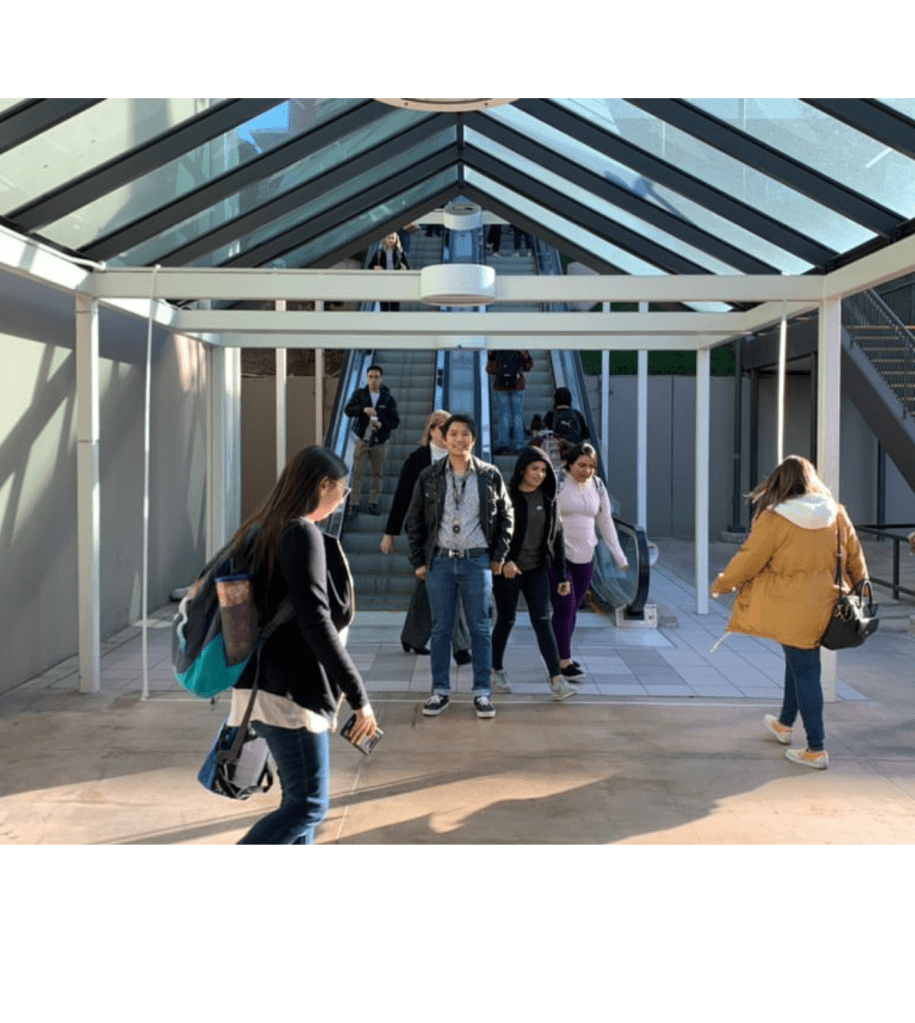
Formal Qualities – large, isolated, descending, ascending, ridged stair belt, endless stair belt, endless handrails, gray stair belt, monochrome, yellow outline on both sides of the stair belt, black handrails, smooth handrails, moving handrails, rubber (elastic) handrails, long handrails, thin handrails, clear balustrade (made of glass), smooth balustrade, thin flat balustrade, still balustrade, smooth shiny middle separator (metal), still middle separator, silver middle separator, silver deck board, smooth deck board, still deck board, long deck board, simple design, practical design, complex inside machinery, cold, hardworking, energetic (filled with energy) or powered, constant, luxury, specialized, incline, paralleled, low noise, heavy, improved, sturdy, aged, auxiliary
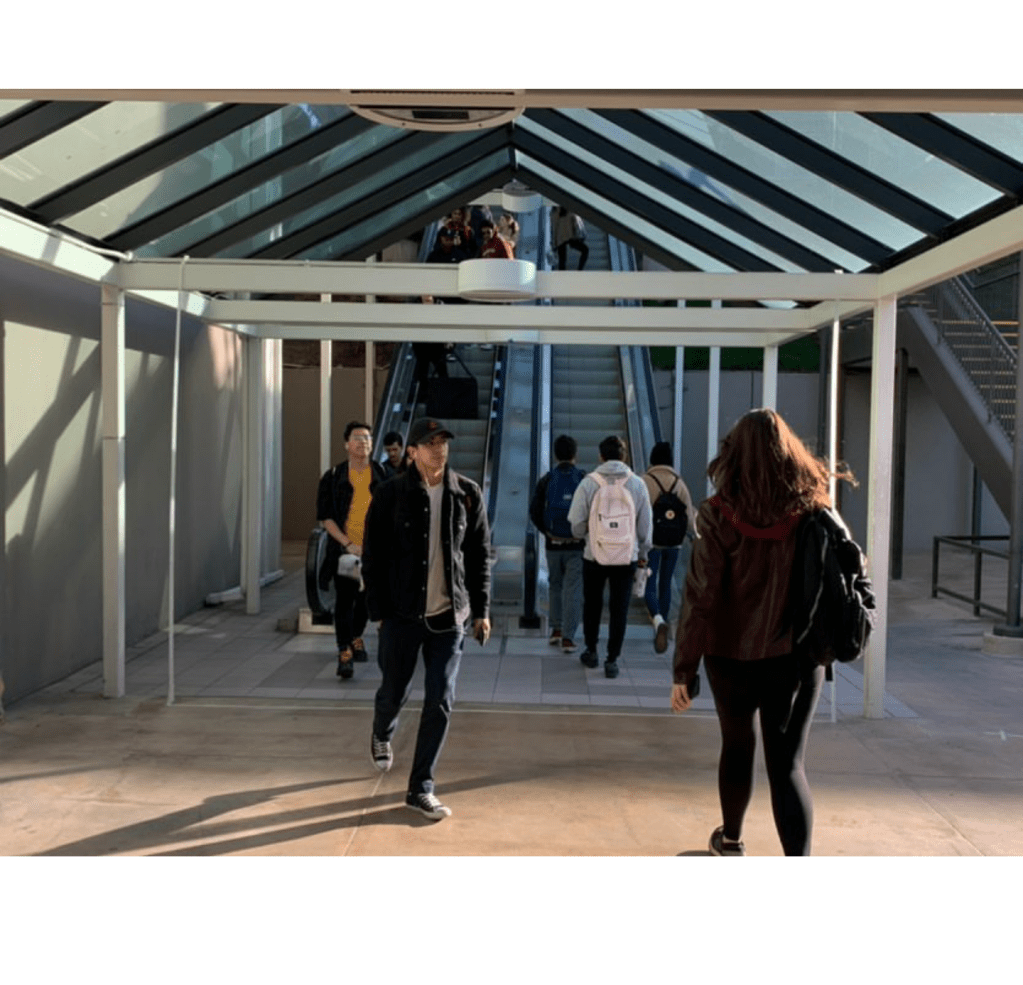
Aesthetics – From the formal qualities of the escalator, I can say that design is pleasant to the eyes. Like most machinery it has a practical simple design. It is not eye catching, nor is it unpleasant to see. It is easy on the eye and integrates itself well with its surroundings to enhance it, without making itself the center of attention. At the same time, it’s size makes it easy to find. The movements from the escalator captures a person’s eyes better than the stilled stair next to it.
Content – It is designed to be eye catching, but at the same time not too distracting. The movement appeals to a person because it sends signals to the brain that it can bring us from place A to B without utilizing our own energy. Representing the present day technology and shows how the world is ever changing, moving, and improving. This is important because it shows that change is not a bad thing or a scary thing, its something amazing that improves our lives, and it was created by ordinary people like us. So it also motivates viewers to contribute to society by creating wonderful works of art.
Was your Art, Art before you put a rectangle around it? Will your Art be Art after the rectangle is gone?
Before we framed the escalator, it was not art. In my eyes, it was art when I looked at it for the first time when I came to California State University of Long Beach and admired it. That was because I had an artful moment with it. That may be because I like to appreciate architectural designs and machinery, however, others who see the same buildings, machinery, or that escalator may not have had that art moment as I had. That’s the reason why I decided that our art piece was not art until we framed it. When it’s framed, it forces any viewers who’s looking at it to focus on what’s inside the frame. To look at the escalator for what it is and ponder about it. Thus, giving the viewer an art moment, so the escalator became art, something everyone can see, ponder, and enjoy. Without the rectangle it may only be art in a few viewers’ eyes that appreciate it, for the majority it would only be a convenient tool.
 ♡ ART 110 • BLOG ♡